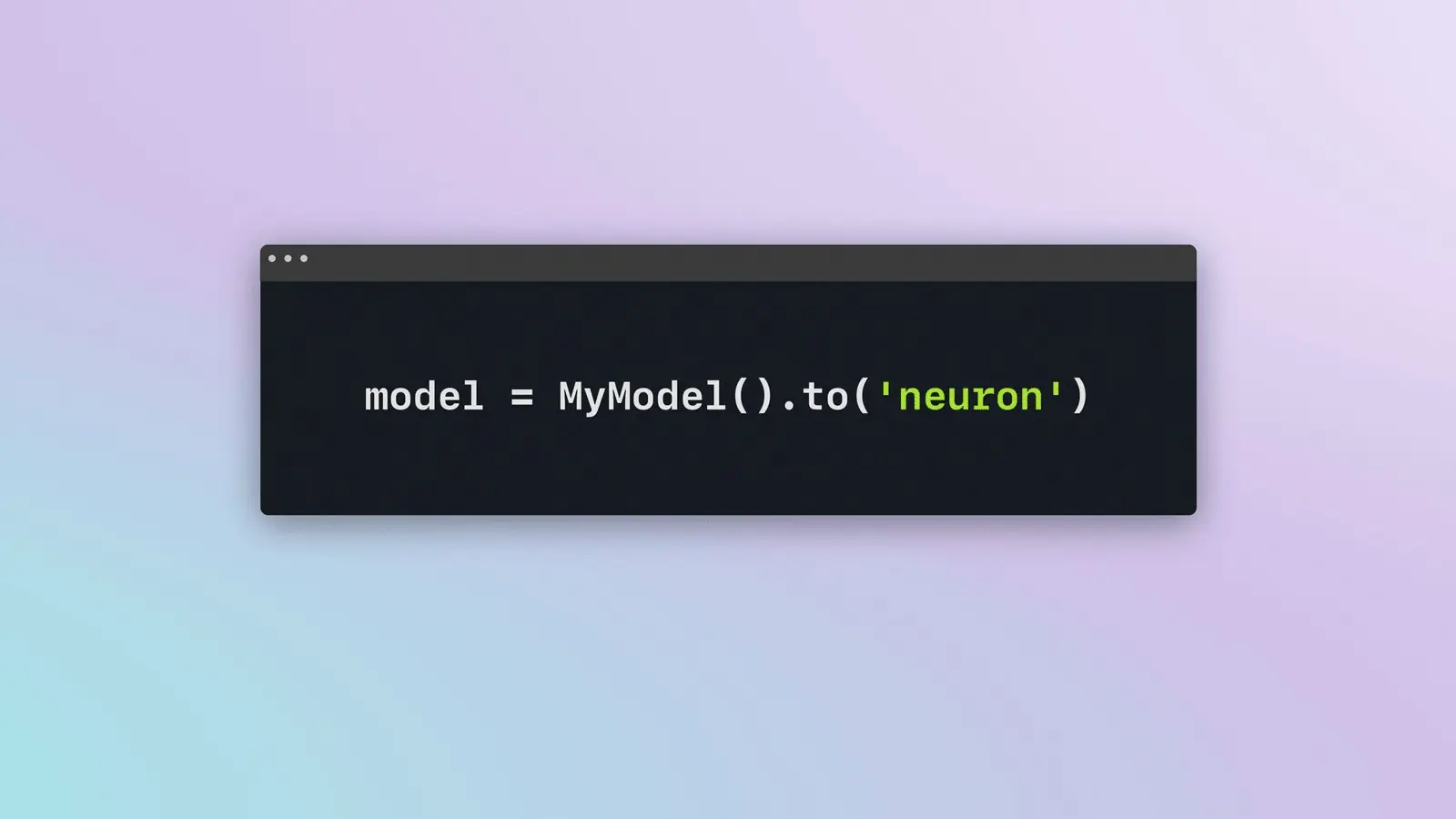
Amazon says its new TorchNeuron backend runs existing PyTorch code on AWS Trainium chips "with a single configuration change and no rewrite," according to Amazon's announcement. As of 4:15 p.m. ET on October 19, Amazon's page says it plans to release TorchNeuron as open source at PyTorch Conference North America on October 20.
What Amazon says TorchNeuron does
- Same code, different chip: In a side-by-side demonstration, Amazon says engineers ran one training script on a conventional chip and on Trainium, changing only a setting that names the chip.
- Same results: Amazon says the model "learned the same things at the same rate."
- Standard hook: Amazon says TorchNeuron uses PyTorch's built-in mechanism for registering new hardware, so existing testing, debugging and scaling tools work unchanged.
- Scaling: It works with TorchTitan and Fully Sharded Data Parallelism (FSDP) for training across Trainium instances.
- Ecosystem: Amazon says Hugging Face now supports Trainium natively, and that it contributed to vLLM and open-sourced its performance kernels.
Chips, instances and licence
TorchNeuron supports Trainium2 and Trainium3, and Amazon says it will use the Apache 2.0 licence. The AWS Neuron documentation says native PyTorch is supported on Trn2 and Trn3, with eager mode, torch.compile and standard distributed APIs.
For existing code, the same page says you "primarily swap cuda for neuron on your tensors." It recommends starting from a Trainium or Inferentia EC2 instance with the Neuron Deep Learning AMI, which bundles the SDK.
Why it matters
Amazon says 85% of AI researchers and developers write their code in PyTorch, and that code has been tied to a narrow set of chips. It says letting developers move between chips "without penalty" forces chipmakers to "earn developers' business."
Much PyTorch code is written for Nvidia's CUDA, which Amazon's page never names. Amazon says moving to new chips has meant rewriting and revalidating work that "took months to perfect," which is the rework it says TorchNeuron avoids.
Amazon's page gives no benchmark figures, no price comparison with Nvidia GPUs and no list of unsupported operations.
The announcement follows other efforts to run AI on non-Nvidia chips, including DeepSeek's reported plan to train on Huawei's Ascend 950DT. More in AI apps.