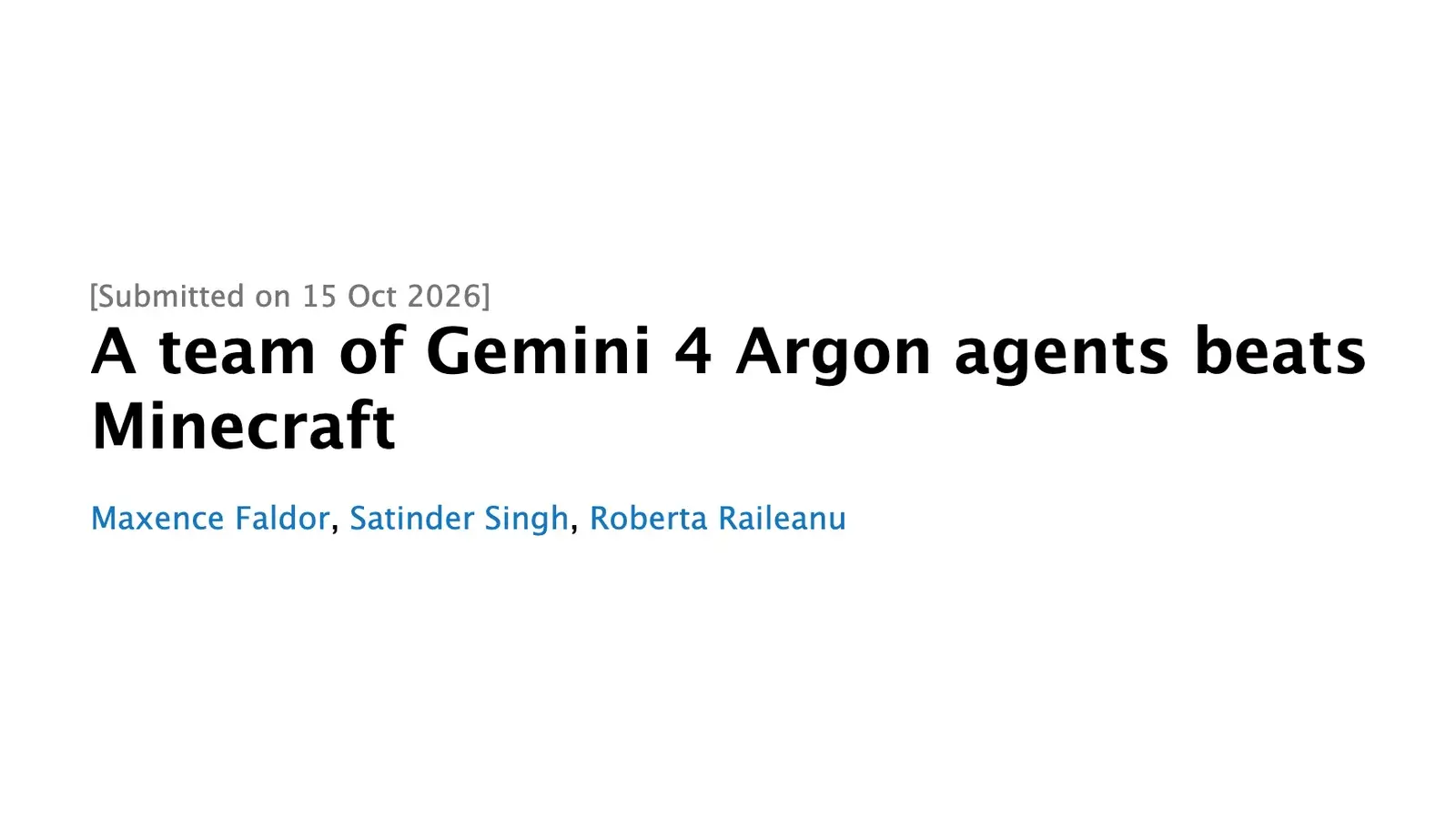
Four Gemini 4 Argon agents beat Minecraft's Ender Dragon as a team, according to a preprint on arXiv by Maxence Faldor, Satinder Singh and Roberta Raileanu of Google DeepMind. Engadget pointed to the paper. It is a research report, not a product announcement.
What the paper reports
The authors put four agents running Gemini 4 Argon in a sandboxed survival world on Easy difficulty, generated from a random seed. Each agent controlled one player through Mineflayer, an open-source library, and the four coordinated through in-game chat and shared memory.
The paper says no one assigned roles or wrote game logic, and that the agents planned, wrote and debugged every program themselves. The team wrote 2,783 programs, died 605 times and defeated the dragon 27 hours and 14 minutes after its first program.
How the run worked
The agents did not see the screen or press keys. Each wrote a short JavaScript program, ran it through Mineflayer, and read text back: position, health, inventory or an error. The paper says the median program ran for 33.5 seconds.
Their only game instruction was a single paragraph saying the goal was to defeat the dragon and that the players decide how to share the work. Ten minutes in, one agent proposed a division of labor in chat, and another answered with a different plan.
Researchers watched a live dashboard and could pause or stop the run at any time, but the paper says they had no cause to intervene. A fifth agent, called the Observer, reported on the game and never played. The paper says neither it nor a manual review of a sample of the logs found cheating.
What the team did
By the paper's account, the agents settled into jobs. One made tools and found the stronghold, one gathered supplies and destroyed six of the ten crystals that heal the dragon, one lit the Nether portal, and one landed the final blow. Three of them built the Enderman shelters.
They also posted coordinates, warned each other of danger, recovered items after deaths and corrected false reports in chat. The server log records the win as a game advancement, and none of the programs used a server command.
The limits the authors state
The paper calls this the first end-to-end autonomous completion of Minecraft by AI agents using only standard Mineflayer, and adds "to our knowledge." It notes two community projects that reported dragon kills with a single agent or added planners, and says its setting differs in what the agents were given. It then lists its own caveats:
- Mineflayer reports nearby blocks and creatures exactly and plans routes, which a player using pixels and a keyboard cannot do.
- Easy difficulty means monsters deal less damage and hunger cannot kill.
- Gemini 4 Argon already knows a lot about Minecraft from training.
- It describes a single run, the first launch tried, so it cannot show how often the setup succeeds.
Why it matters
The authors argue that long-horizon coding and multi-agent coordination are what real-world software tasks also need. The paper makes no claim about a Google product or release.
For readers who follow AI apps, the useful detail is the scale of the effort: about 1.35 billion input tokens, which the paper prices at roughly $520 at the introductory list price for the four players, an estimate and not Google's serving cost.