Bloomberg reported, via 9to5Mac, that Judge Edward Davila said at a hearing on Oct. 14 he is "highly likely" to grant Apple's request for a preliminary injunction against OpenAI. OpenAI agreed not to use the trade secrets Apple says were stolen while the case continues. These are allegations, and the reported agreement does not establish the alleged misconduct.
What was agreed
Per Bloomberg, quoted by 9to5Mac, OpenAI agreed "not to use trade secrets that Apple Inc. claims were stolen." It also committed to collecting forensic images of devices from 14 employees "that may contain Apple's confidential information."
Bloomberg, as relayed by 9to5Mac, says Davila can enforce the agreement, so OpenAI could face sanctions for breaking it. The judge also called Apple's request to inspect every device and repository that might hold its secrets a "huge ask," per the same report.
Apple's attorney John Desmarais answered, per 9to5Mac's summary of Bloomberg, that Apple would limit inspections to a small group of former employees. He said OpenAI does not have "400 bad apples," only "a few bad apples."
The case so far
Apple sued in July, naming former employees Chang Liu and Tang Tan, OpenAI and io Products. 9to5Mac says Apple alleges they used its confidential information to advance OpenAI's consumer hardware work, and obtained information from other Apple employees in recruiting interviews.
On Oct. 13, per 9to5Mac, Davila granted Apple's expedited-discovery motion in part. 9to5Mac's reading of the order includes forensic images the defendants had already collected and documents used to interview Apple candidates. He sent requests for OpenAI's metal-finish, power and battery documents to regular discovery.
OpenAI's counter-allegation
On Oct. 14, OpenAI filed a supplement to a case management statement. It says a former OpenAI employee, who joined from Apple and has since returned, sent "over a hundred highly confidential files about at least one unreleased OpenAI device" to personal accounts.
The filing says the files include images of the device, engineering and manufacturing data, supplier information and standards for cosmetic finishes. It says some were sent on June 2, the employee's last day at OpenAI, and asks to investigate and, "if necessary," pursue counterclaims.
Apple told Reuters, per 9to5Mac, that it has found no evidence for the claim and has policies to keep new hires from using former employers' confidential information.
On the broader suit, OpenAI has called it "careless, aggressive and oddly personal," saying it does not "have, nor want, any of their trade secrets."
Court records
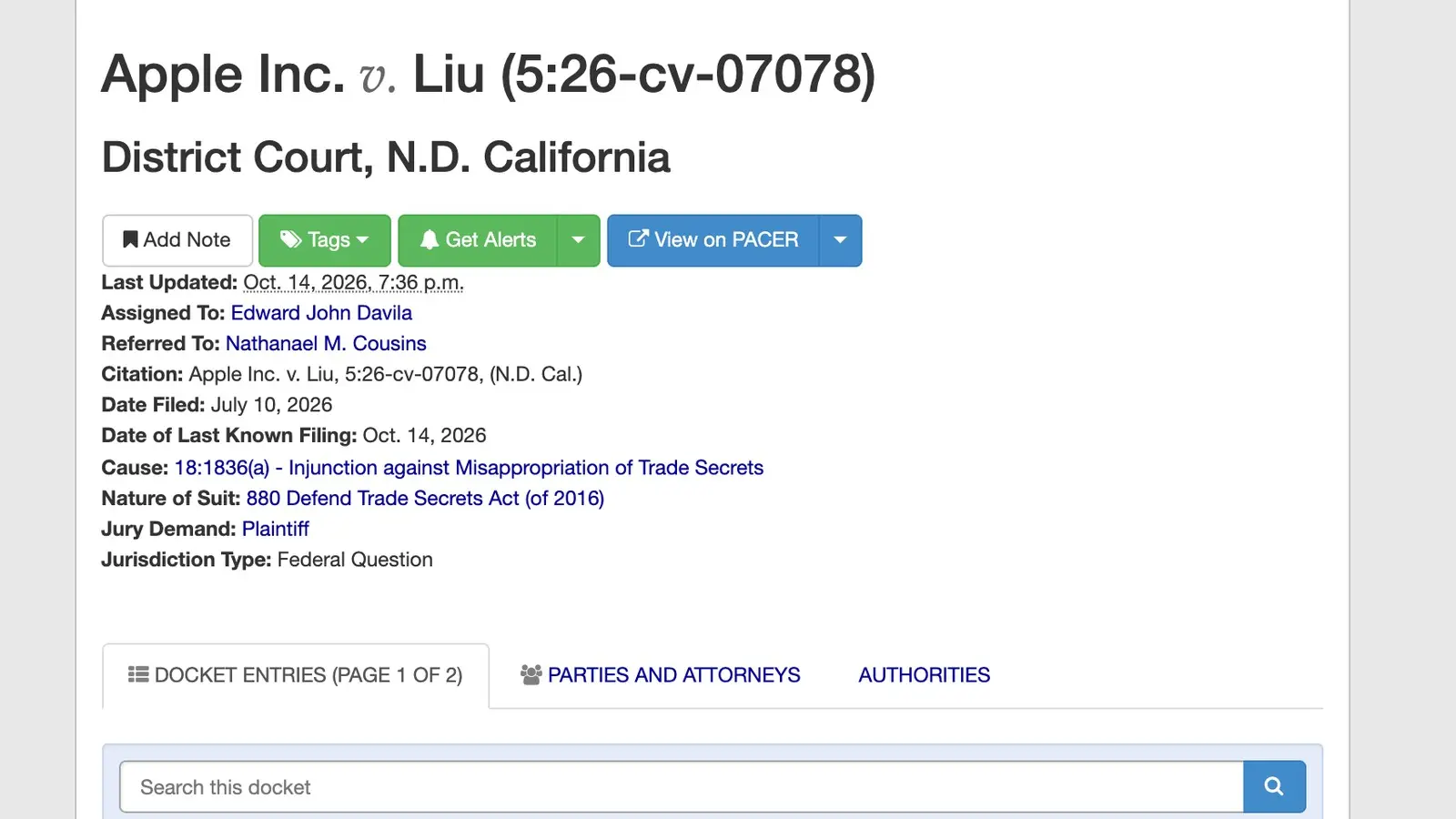
CourtListener's docket for Apple Inc. v. Liu, No. 5:26-cv-07078 in the Northern District of California, San Jose division, lists OpenAI's filing and the Oct. 13 discovery order. As listed on that page, which showed filings through Oct. 14, there is no minute order or stipulation for the hearing, so the agreement's terms rest on Bloomberg's account.
Why it matters
This section is our opinion.
In this case, 9to5Mac's report on the discovery order says Apple asked for forensic evidence, internal documents and employee testimony, including documents from interviews with Apple candidates. For OpenAI, the filing shows the dispute reaching its unreleased device. Bloomberg, quoted by MacRumors, says an injunction would "mark a potential setback" for OpenAI's hardware efforts.
None of the sources says what the device is, when it ships, or whether the agreement changes any plan. A preliminary injunction would be a ruling on interim relief, not a finding that anyone is liable. Treat the underlying claims as unproven.