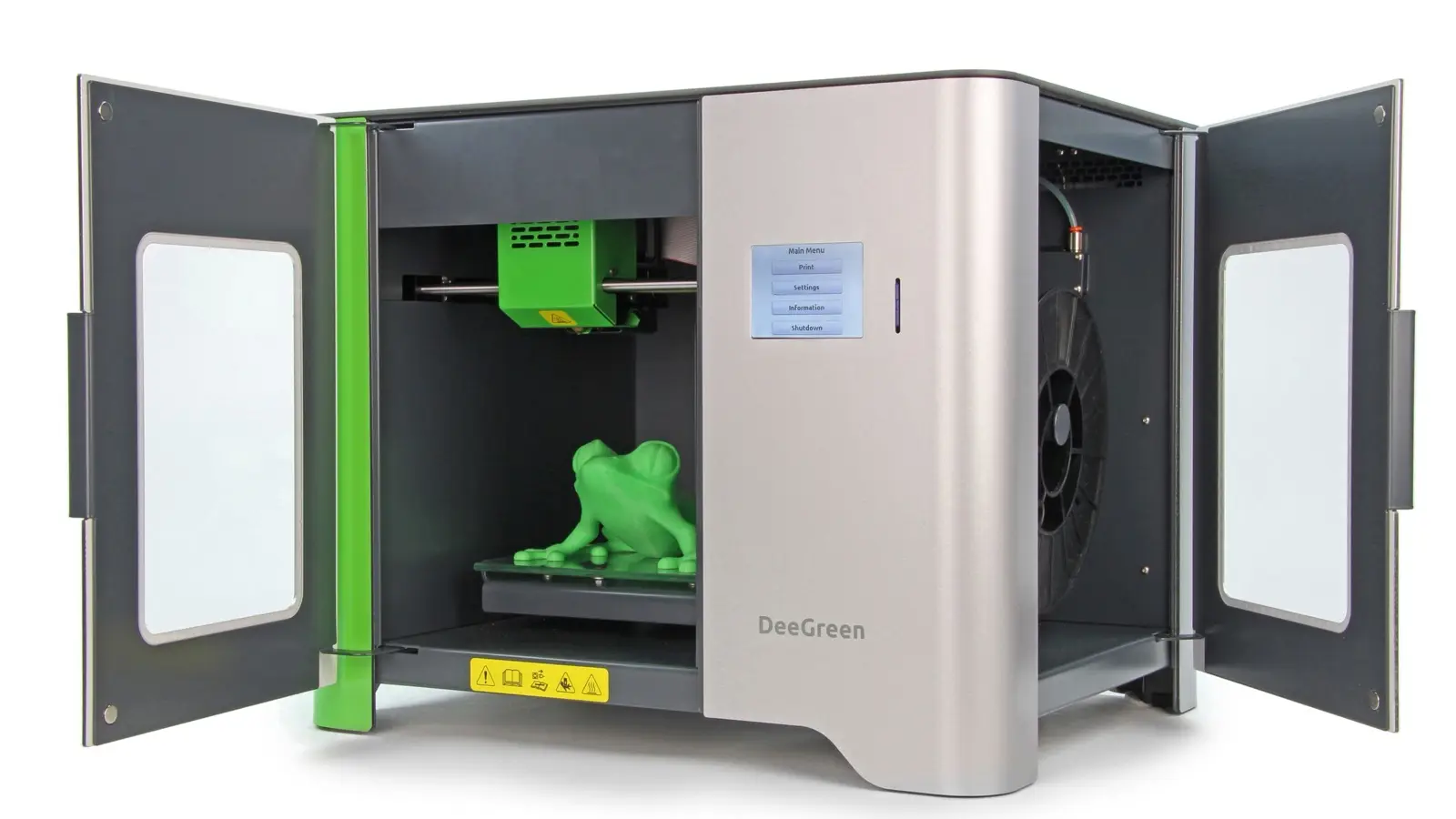
Is 3D printing safe indoors? The sources do not give a plain yes or no. EPA says 3D printers release volatile organic compounds (VOCs) and ultrafine particles, so treat indoor printing as an air-quality question. NIOSH says the filament you choose and the ventilation you use both affect exposure.
This guide covers air quality only. Burns from hot surfaces, moving parts and fire risk are outside it.
Here is what the printer puts in the air, what the research does and does not show, what NIOSH recommends, and a home setup. RR Tech Pulse did not test or measure anything. Every point comes from EPA, NIOSH or one research paper, except where we label it as our own.
What the printer puts in the air
EPA says printing releases gases, or fumes, including VOCs, some of which are hazardous to human health when inhaled. It also releases ultrafine particles, 1 to 100 nm in size.
EPA says these particles can be deposited deeper in the respiratory system. EPA adds that they can be more difficult to clear from the body than larger solid particles.
Filament matters. EPA says different filaments release different amounts of respirable particles. Specialty filaments with additives, such as metal particles or metal-containing flame retardants, may add health risks.
What the research does and doesn't show
EPA says published studies on 3D printer emissions and respiratory health are limited. All of them studied adults only. EPA also notes that children may be exposed in classrooms and libraries.
EPA modeled children's lung dose; it did not measure it. The model predicted the greatest mass deposition in children aged 9 to 18, and that the greatest deposition would be in the lungs.
A 2023 pilot study in Frontiers in Public Health measured exposure in two research labs. One lab had a PLA printer and the other a resin printer. Three people in each lab wore personal monitors.
Personal exposure averaged 2,203 particles/cm³ for the PLA printer and 4,091 particles/cm³ for the resin printer. The resin lab had the higher average. Do not read that as a clean printer-versus-printer comparison: the readings were not corrected for background particles, the PLA room was ventilated and the resin room was not, and the resin monitoring included washing and curing.
The authors say WHO's 2021 guidelines set no limit for ultrafine particles, so they compared against particle-count reference values for 24-hour and one-hour averages. They report the PLA lab's average ambient reading as lower than the WHO guidelines. The resin lab's was higher than the 24-hour reference but lower than the one-hour reference.
This is a pilot study of two printers in two labs. It did not measure homes.
What NIOSH recommends
NIOSH's poster is workplace guidance, not home advice. It recommends:
- Choose a filament with lower known emission rates when possible. The poster's example is polylactic acid (PLA) rather than acrylonitrile butadiene styrene (ABS) "when possible".
- Choose the lowest printing temperature that gives the result you need.
- Use HEPA-filtered local exhaust ventilation placed near the printer.
- If VOCs are a concern, add gas and vapor filters to that exhaust.
- Use a ventilated enclosure around the printer.
- Reduce time spent near the printer, or monitor it remotely.
NIOSH also lists a higher potential for exposure when you go to the printer right after a print failure or at start-up, and when you clean with solvents.
A practical setup at home
This section is our reading of the NIOSH advice above. We did not test it, and no source we read tests a home setup.
- Pick a filament with lower known emission rates, and print at the lowest temperature that prints well.
- Keep the printer out of your bedroom. This is our suggestion, not a source's.
- Use HEPA-filtered exhaust near the printer, as NIOSH describes for workplaces.
- Add a gas and vapor filter if VOCs worry you. NIOSH names this filter type.
- Use a ventilated enclosure, as NIOSH lists.
- Check prints on a camera instead of standing next to the printer.
- Do solvent cleaning where exhaust or a ventilated enclosure is available, as NIOSH lists for post-processing.
Resin printers
The pilot study is the only source we read that measured a resin printer. In that test, the resin printer had the higher average particle count, in one lab. We found no other source on resin emissions, so we make no safety claim for resin. Following the resin maker's safety data sheet is our suggestion; the sources we read do not cover resin handling.
What we could not confirm
- We did not test or measure anything. RR Tech Pulse measured no printer, room or air.
- We read no study of printing in an ordinary home.
- The sources we read set no safe level for ultrafine particles.
- Vendor and hobby pages make fume claims beyond the EPA and NIOSH points above, such as specific filters that remove them. We found no source we could check for those, so we do not repeat them.
- We read no emission data for PETG, ASA or nylon. NIOSH gives one example, PLA rather than ABS "when possible", and nothing more.
This is not medical advice.