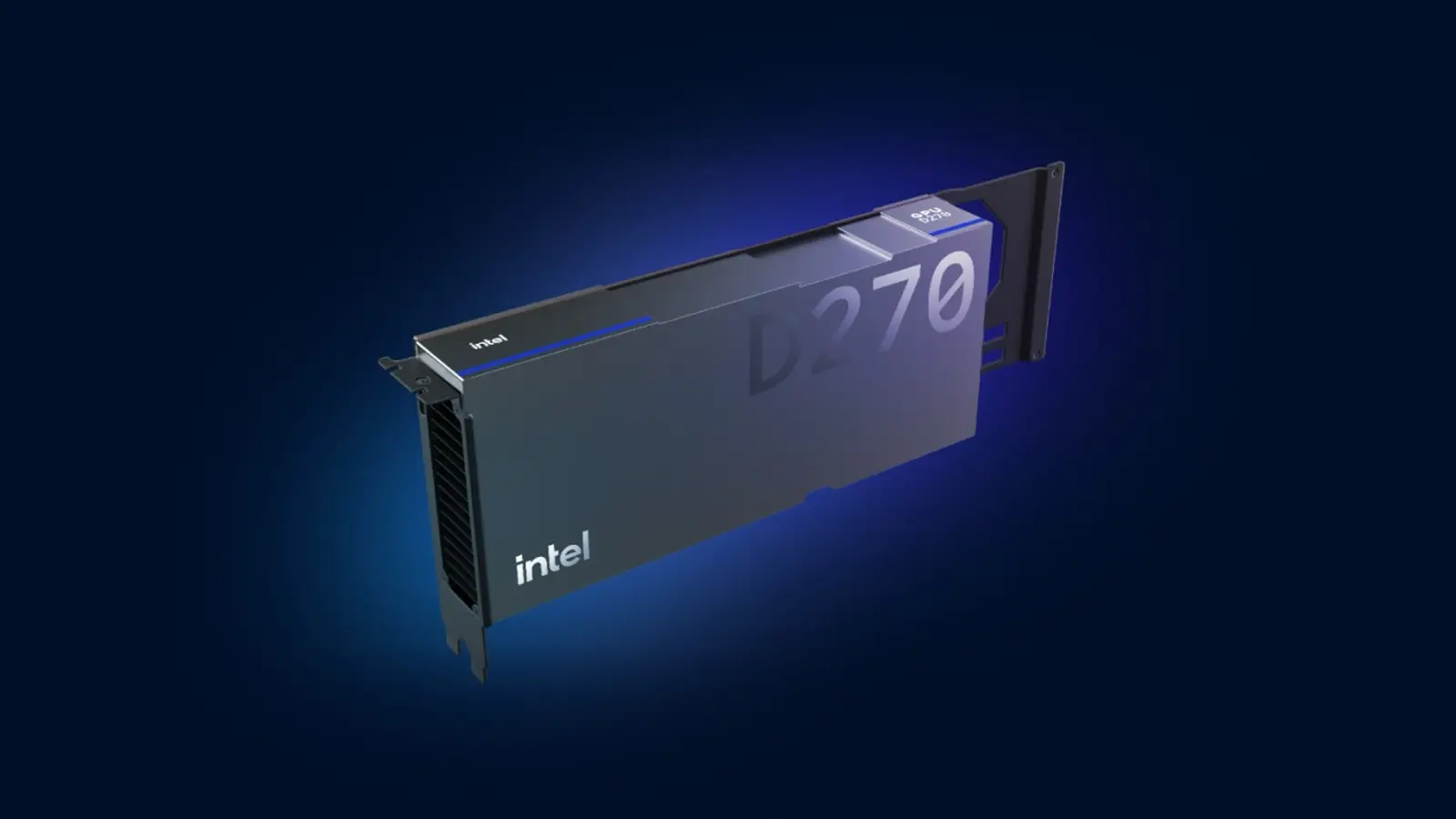
Intel's new GPU D270 has "GPU" in its name but no graphics or ray-tracing hardware. It is a card in Intel's new D-series, the new name for Crescent Island, and it is aimed at running AI models in data centers. Intel's description lists AI inference and no gaming features. Memory tops out at 480GB; the reference card is reported at 160GB (StorageReview, ServeTheHome). Intel says it is sampling to customers and has given no price or release date.
Why it matters
This card is about capacity and cost. It carries up to 480GB of memory, and Intel says it is meant to improve the economics of running AI services.
What Intel announced
- Intel announced the D270 on October 12, 2026 at the Open Compute Project Global Summit.
- It is built on Intel's Xe3P architecture, with 32 Xe3P cores and 256 matrix engines (XMX), per Intel's product page.
- Intel says it removed the graphics and ray-tracing hardware and used that chip area for AI compute. Going by that description, it is an AI inference card with no gaming or 3D rendering features listed.
- Intel lists a 350W power rating, air cooling and a standard PCIe 5.0 slot.
- Intel quotes up to 1.5TB/s of memory bandwidth and 1.3 petaflops of peak FP8 compute (a low-precision number format used for AI inference). Both are Intel's figures, and we have found no independent tests.
Why the memory choice matters
The D270 uses LPDDR5X, the memory family found in phones and laptops, instead of the HBM stacked memory on high-end AI accelerators. Intel's product page says this lets it keep more of a model and its long context in memory with fewer GPUs and no HBM.
The trade-off is speed. StorageReview says 1.5TB/s sits well below HBM-class accelerators, and Wccftech lists AMD's Instinct MI350P at 144GB of HBM3E and 4TB/s. We have not checked AMD's figures against AMD. Wccftech also notes that HBM supply is tight and prices have risen, which is the opening Intel is aiming at.
Per StorageReview and ServeTheHome, Intel's own card carries 160GB and partner (ODM) versions can reach 480GB.
Who it is for
Intel targets enterprise AI, software-as-a-service, GPU cloud and government or sovereign-cloud deployments. Intel claims one card can run models of up to 300 billion parameters, and an eight-card system can run models of more than one trillion. Those are Intel's claims, not test results.
What it means for you
Intel says customer sampling is underway, but has not announced commercial availability, and the card is not for gaming PCs. The effect, if any, is indirect: Intel says the card is meant to cut the cost of running AI at scale. Whether that reaches prices for AI services depends on pricing and adoption, and Intel has announced neither.
What we don't know
Intel has not published a price, a launch date or third-party benchmarks. Its product page cites a comparison with Nvidia's RTX Pro 6000 based on Intel's own analysis as of February 2026; we are not repeating it. RR Tech Pulse has not tested the card.