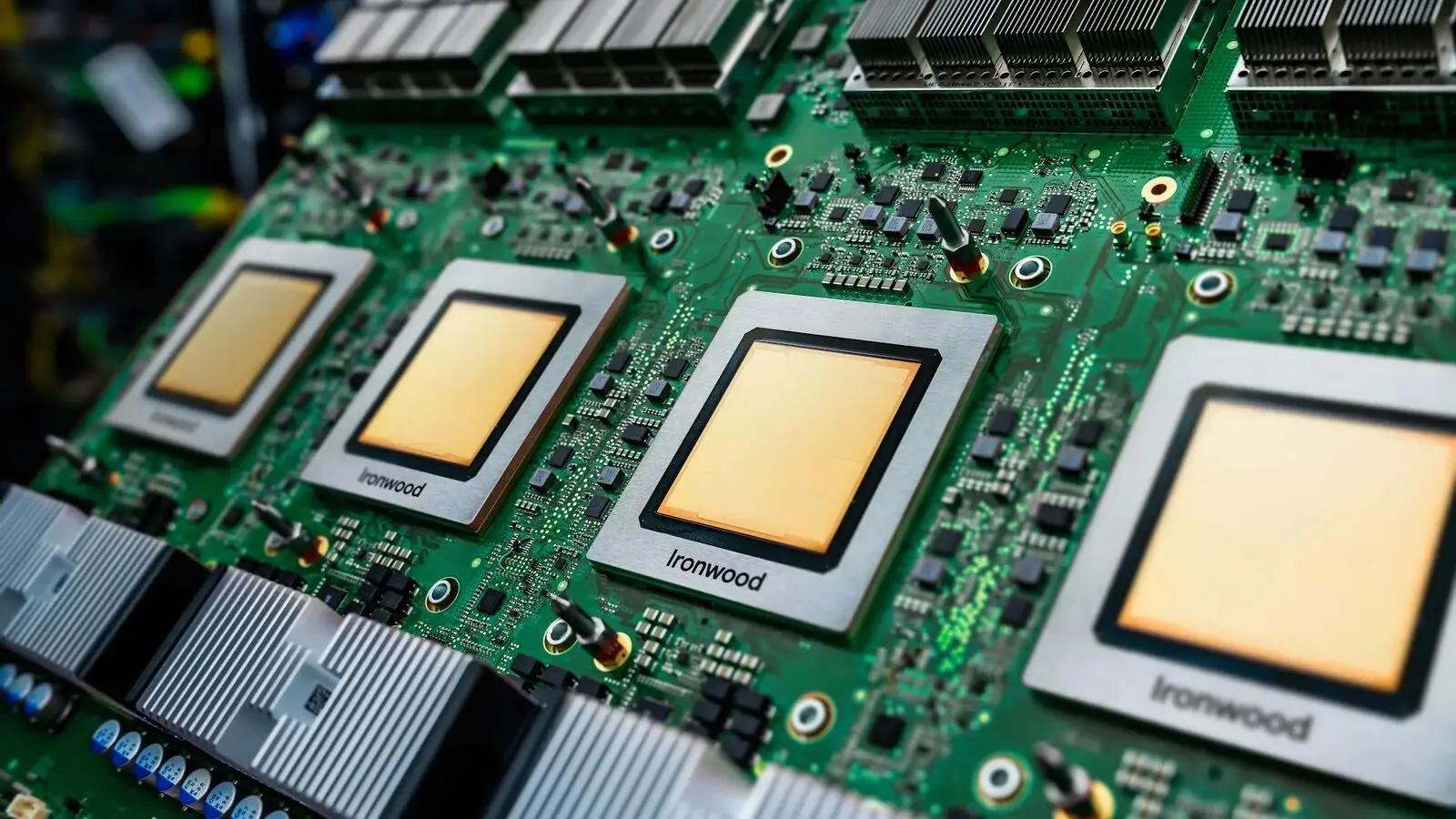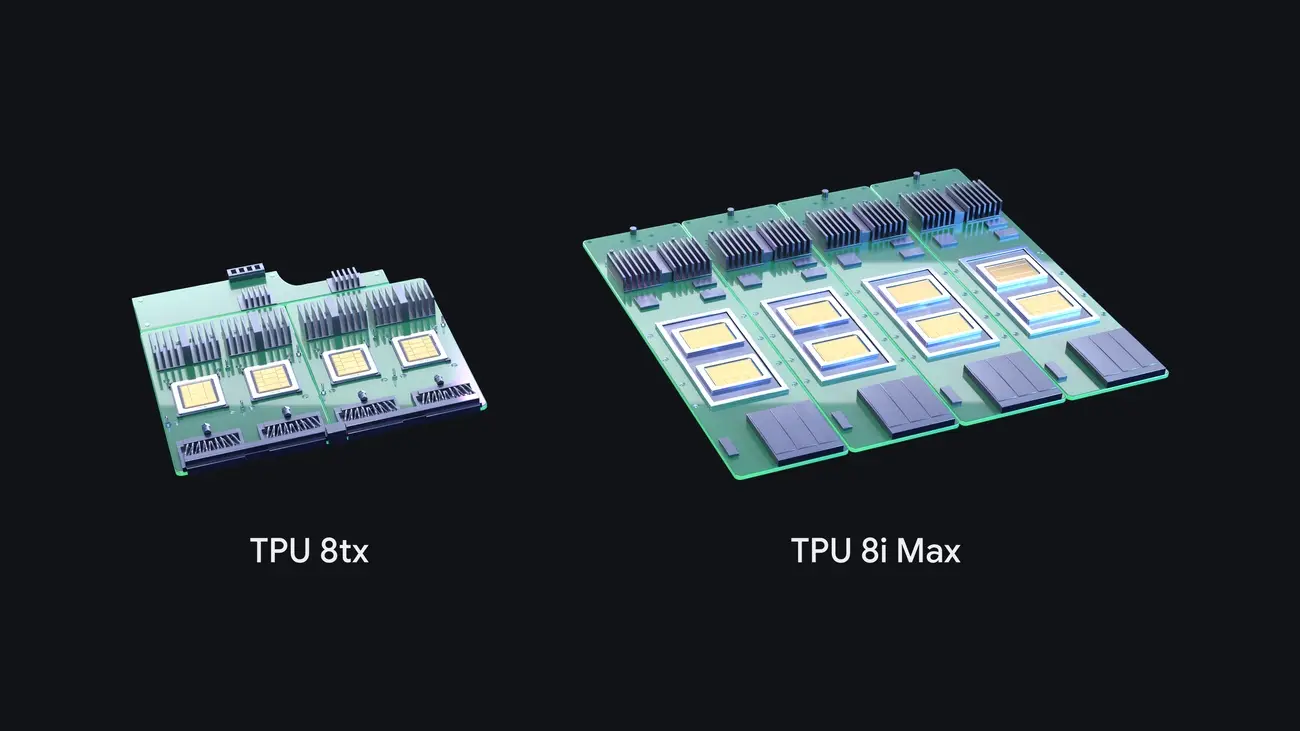
Google has added two systems to its eighth-generation TPU (Tensor Processing Unit, its in-house AI chip) lineup: TPU 8tx, aimed at secure and confidential inference, and TPU 8i Max, built for large context windows. Google announced them on Nov. 9 in a post by Amin Vahdat, its SVP and chief technologist for AI and infrastructure.
TPU 8tx: confidential inference
Google says TPU 8tx is built for regulated enterprises and governments that run models and agents next to sensitive data. It says the system keeps data and model weights protected even while they are in use, not only when stored or sent over a network.
It uses the same silicon as TPU 8t, paired with 5th Gen AMD EPYC host CPUs. Google says it also suits small-scale training, such as fine-tuning on private data.
Google also says TPU 8tx uses Boardfly, a chip-to-chip network design first built for real-time reasoning, and that this gives "up to 2x lower latency compared to TPU 8t" with a near-zero performance penalty.
TPU 8i Max: two 8i chips on one package
Google says TPU 8i Max combines two TPU 8i chips on a single package. It claims double the compute, double the SRAM and double the HBM bandwidth of TPU 8i.
Because the package fits twice the silicon in the existing rack footprint, Google says data centers can run more compute per square foot and per watt. Its stated target is workloads, such as many agents working across a large codebase, where memory bandwidth becomes the bottleneck.
Where this fits
TPU 8tx and TPU 8i Max follow the TPU 8t (training) and TPU 8i (reasoning) that Google announced in April at Cloud Next, in its post of April 22; they are separate from those chips. Google says they offer up to 2.7x better training performance and 80% better inference price performance, respectively, versus the previous generation. The two new systems make four in one year, which Google says is a first.
Google also says TPUs now have nearly 100 customers.
What we checked, and what Google did not say
The post gives no availability dates, pricing, per-chip specifications or word on who can use either system. The "2x" figures are relative to other Google parts, and the post does not show the test setup. We did not find independent benchmarks.
Related
For another Google TPU story, see Project Suncatcher's first AI reply from orbit. For AI compute on Google Cloud, see OpenAI's GPT-6 models on Google Cloud. More is in Computing.