The short version
A portable SSD's box shows one big number. The things that decide whether you get it are the USB name, your port and cable, and what you plan to do with the drive.
Read the interface name first, because the headline figure needs a port and cable that can carry it. iPhone ProRes recording sets its own drive, cable and format rules. A drop height and an IP rating are separate claims, tested by the maker. All four drives list five years of warranty, but two end early on wear.
We tested none of these drives. Every figure comes from a linked standards body, maker or store page.
What the USB names mean
The USB Implementers Forum says USB 3.2 identifies three transfer rates: 20Gbps, 10Gbps and 5Gbps. The 20Gbps rate comes from "up to two lanes of 10Gbps operation", which is why a 20Gbps drive is called Gen 2x2.
Apple's Final Cut Camera guidance uses the same labels: USB 3.2 Gen 2 is 10 Gbit/s and USB 3.1 Gen 1 is 5 Gbit/s. So a "Gen 2" drive and a "Gen 2x2" drive are different speeds, and the x2 is the part to look for.
USB4 sits above that, with up to 80 Gbps over 80 Gbps certified cables. The USB-IF's language guidelines list "USB 40Gbps" as the marketing name for a product that signals at 40Gbps, so a box with that label is USB4. Look for the Gen number or the Gbps name.
Why the headline speed needs the right port
Samsung's footnote on the T9 page is the clearest statement of the catch. To reach the maximum sequential speeds, it says, "the host device and connection cables must support USB 3.2 Gen 2x2 and the UASP mode must be enabled."
That is Samsung describing its own drive. The port, the cable and the software mode all have to match, not just the drive.
Kingston's XS2000 datasheet is shorter: "Speed may vary due to host hardware, software and usage." Before you pay for a drive in this speed class, check what your laptop's port is rated for, and use the cable in the box.
Sustained speed
No maker page we read publishes a sustained speed, meaning what a long copy settles at. Samsung says "Performance may vary depending on host configuration", and Kingston's line above is the whole of its caveat.
Tom's Guide is one outlet that does run its own copy test, a 25GB file transfer on each drive it ranks, though its page gives no sustained-speed figure. We have tested nothing, so treat the box speed as a claim, not a measure of a long transfer.
iPhone recording and Android file management
Apple's ProRes page says iPhone 17 Pro, 16 Pro and 15 Pro models can record ProRes straight to an external storage device over USB-C. The drive must be formatted exFAT, and password-encrypted drives are not supported.
Apple says the drive must write at least 220 MB per second for 4K60 ProRes and at least 440 MB per second for 4K120, with a maximum power draw of 4.5 W. Apple also says to reformat the drive before each 4K120 session.
For cables, Apple's ProRes page asks for a USB 3 cable of at least 10 Gbits per second. Final Cut Camera's page says a 5 Gbit/s cable is enough for 4K60 and 10 Gbit/s is needed for 4K120.
Apple's external storage page says a drive that does not supply its own power can use a powered USB hub.
For Android, Google's USB storage page says USB storage works on Android 7.0 and up, and that you can move, copy, delete and rename files on it. That page covers file management only, not recording.
Rugged claims: IP ratings and drop tests
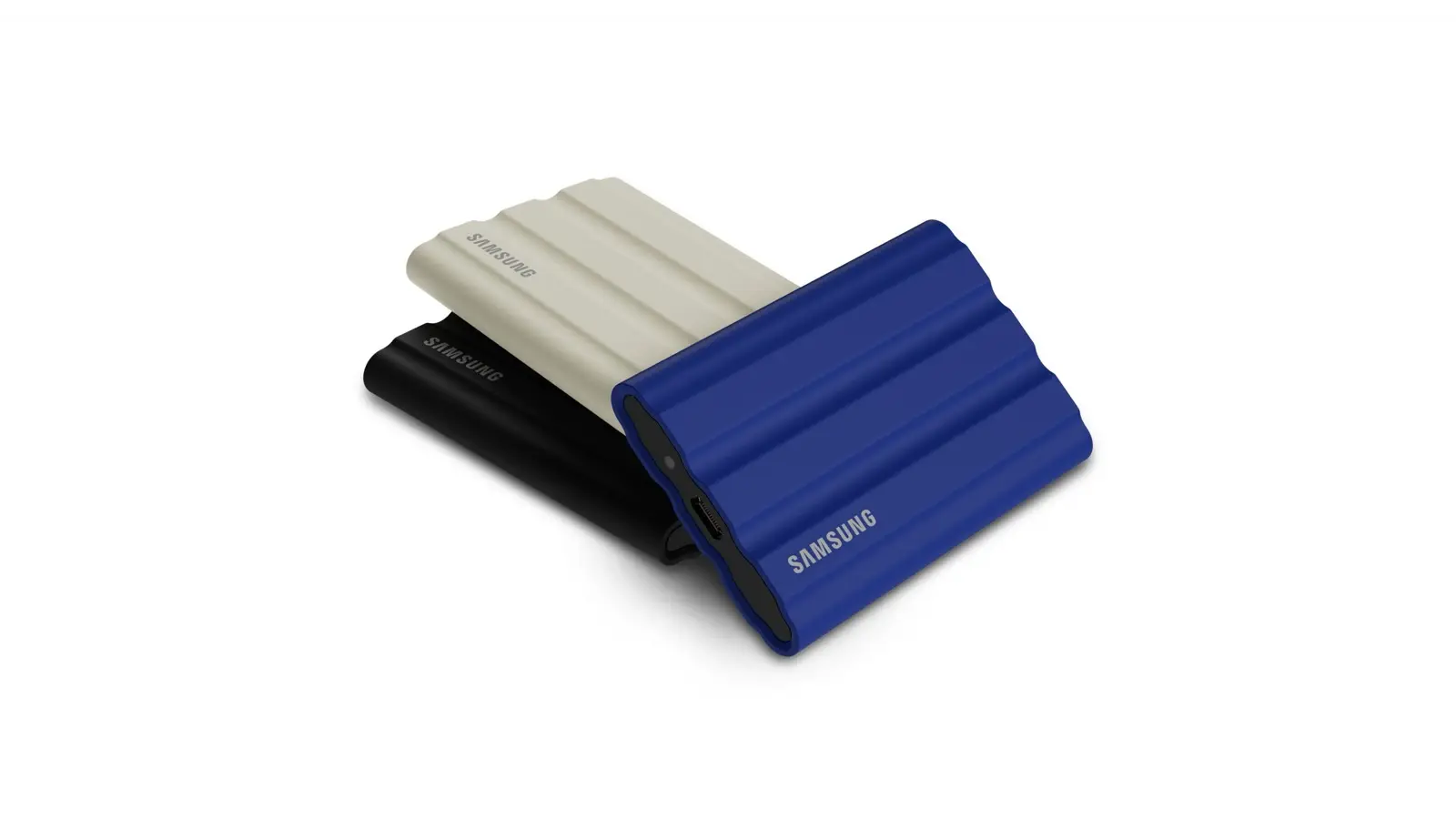
Both claims are the maker's own. Samsung lists the T9 as "up to 3-meter drop resistant", based on an internal free-fall test, and its product page gives no IP rating. SanDisk's Extreme V3 page lists IP65 and up to 3-meter drop protection.
Kingston's datasheet says the XS2000 has "IP55 rating with removable rubber sleeve", certified to withstand water flow and limited dust contact under IEC/EN 60529, with drop testing done internally. It does not state a drop height. Crucial's X10 Pro page lists IP55 and drop resistance to 7.5 ft (2 m).
Read the fine print. Kingston's rating is tied to the sleeve, and Samsung's drop figure is a lab result. Neither is the same as an independent test.
Warranty and hardware encryption
Samsung and SanDisk list a five-year limited warranty. Kingston words it as "5 years or 'SSD Life Remaining'", so wear can end it earlier, and its datasheet states no encryption. Crucial's runs to 5 years or the maximum TBW, its total-bytes-written rating.
Samsung lists AES 256-bit hardware encryption and an optional AES 256-bit password. The password is optional, so you can leave it off.
Four 1TB drives, side by side
Maker-stated figures, from the linked pages. Samsung figures come from its Canada page.
| Drive | Speed (maker) | Rating (maker) | Warranty |
|---|---|---|---|
| Samsung T9 | Up to 2,000 MB/s | 3 m drop, no IP rating listed | 5 years |
| Kingston XS2000 | 2,000 MB/s read and write | IP55 with sleeve, no drop height | 5 years or SSD Life Remaining |
| SanDisk Extreme V3 | Up to 2,000 read, 1,700 write (MB/s) | IP65, 3 m drop | 5 years |
| Crucial X10 Pro | Up to 2,100 read, 2,000 write (MB/s) | IP55, 7.5 ft (2 m) drop | 5 years or max TBW |
All four state speeds near that mark, so the port and cable caveat above applies to all of them.
US prices, 1TB, Oct. 17
Prices were read on Amazon.com between 12:20 and 12:29 PM ET on Oct. 17, with delivery set to a New Hampshire ZIP code. Stock and prices change often, so check the page before you buy.
- Samsung T9: $247.00, sold by Amazon.com, in stock. Amazon shows a $287.99 list price.
- Kingston XS2000: $239.00, in stock, sold by a third-party seller, Perfect Stock.
- SanDisk Extreme V3: $247.47, sold by Amazon.com.
- Crucial X10 Pro: $199.99, sold by a third-party seller, Vivids Computer, with only 6 left.
The two cheapest drives are both sold by third parties, not by Amazon or the maker. Check who sells the one you pick.
Which to pick
For iPhone ProRes, pick the Crucial X10 Pro at $199.99 or the Kingston XS2000 at $239.00. Both state a write speed near 2,000 MB/s, well above Apple's floors of 220 and 440 MB/s. SanDisk states 1,700 MB/s write, also above both floors, at $247.47.
Apple also caps drive power at 4.5 W, and no maker page lists power draw, so write speed is all we can compare.
For a drive that gets knocked around, the SanDisk Extreme V3 has the highest rating listed, IP65 with a 3 m drop claim, sold by Amazon.com.
If you want the lowest price, the Crucial is it, though a third party sells it. If you want Amazon.com as the seller, the Samsung T9 is $247.00, with a 3 m drop claim and no IP rating listed.
These picks rest only on the maker specs and prices above, and a slower laptop port will cap whichever you buy.
For desk-bound storage, our SanDisk Desk Drive 8TB price check covers a desktop SSD, and the Samsung 990 EVO Plus 1TB deal covers an internal one.
What we could not confirm
The USB-IF pages do not give Thunderbolt speeds, so we left them out. Kingston's datasheet gives no drop height or encryption, and Samsung's product page lists no IP rating. We ran no independent test of these drives.